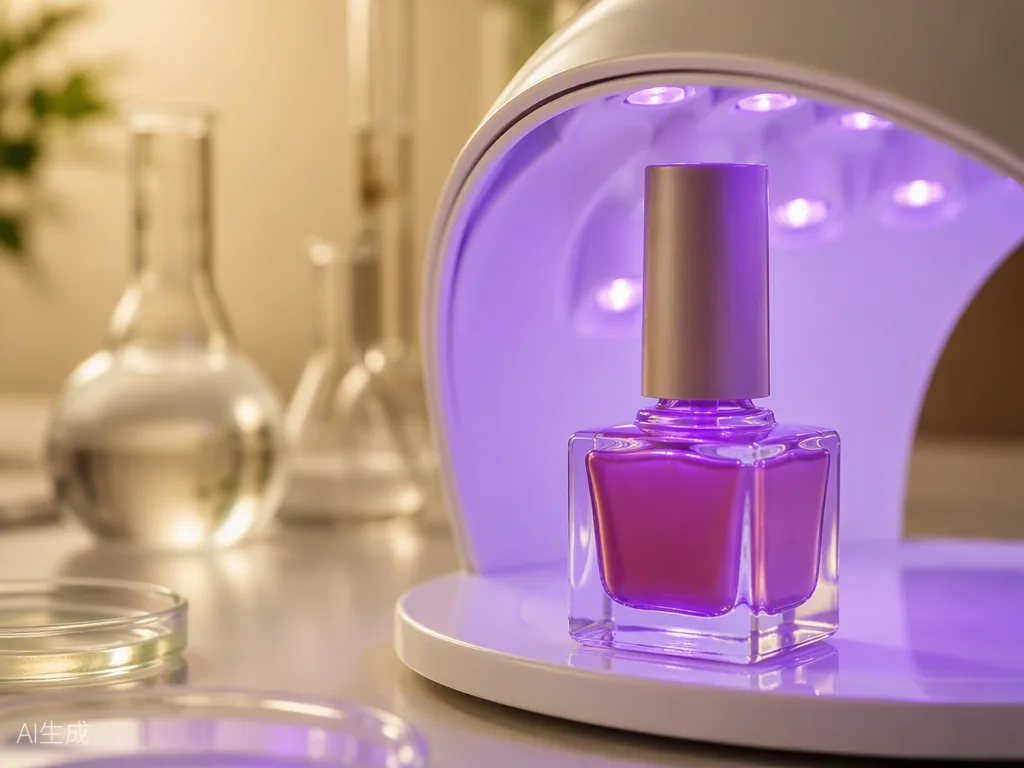
Identify the ingredient and its job
Ingredient conversations become clearer when names, functions and product states are kept separate. HEMA (2-hydroxyethyl methacrylate) and Di-HEMA TMHDC are reactive methacrylate ingredients used in certain nail systems. Other acrylates and methacrylates can serve different formulation roles; a shared chemical-family word does not make them interchangeable or prove that every product carries the same risk.
TPO, whose INCI name is Trimethylbenzoyl Diphenylphosphine Oxide, is a photoinitiator used to help initiate curing under appropriate light. A photoinitiator is only one part of a formula. The curing outcome also depends on the complete system and the manufacturer’s specified lamp, wavelength compatibility, layer thickness, application and time.
Separate four layers of the question
| Layer | Question | Evidence to consider |
|---|---|---|
| Ingredient hazard | What adverse effect can this substance cause under some conditions? | Hazard classification and scientific assessment |
| Exposure | How much, how often, by which route, and in what product state? | Uncured skin contact, working practice, inhalation routes and task frequency |
| Specific product risk | How do hazard and exposure combine for this formula and intended use? | Exact composition, users, directions, controls and product safety assessment |
| Legal requirement | What does the destination law require for this product now? | Applicable annexes, dates, warnings, user restrictions and duties |
These layers must not collapse into a slogan. A hazard does not mean every exposure produces harm; a lower-exposure use does not erase a legal restriction. Equally, a product-specific risk conclusion cannot be drawn from a single INCI name alone.
“Free-from” is a composition claim, not an automatic safety conclusion
Removing one named ingredient does not establish that the reformulated product is safer overall. Examine the replacement ingredients, complete INCI list, SDS, directions, exposure pattern, curing requirements and market rules. A “free-from” statement also needs to be truthful for the exact SKU and should not distract from the remaining hazards or required controls.
What the EU rules actually say
HEMA and Di-HEMA TMHDC: professional-use restriction
Commission Regulation (EU) 2020/1682 amended Annex III to the EU Cosmetics Regulation. For nail products containing HEMA or Di-HEMA TMHDC, it sets the condition professional use only and the package warnings “For professional use only” and “Can cause an allergic reaction”. This is a targeted restriction with conditions and warnings, not a blanket prohibition on every nail product containing those ingredients.
The regulatory recitals discuss sensitisation from misuse, inappropriate application and unintentional contact with skin next to the nail. That is why precise application and keeping uncured product off surrounding skin matter, rather than treating professional status as a substitute for control.
TPO: prohibition in EU cosmetics from 1 September 2025
Commission Regulation (EU) 2025/877 deleted TPO’s previous entry from Annex III and added the substance to Annex II, the list of prohibited substances. Article 2 states that the regulation applies from 1 September 2025. Therefore, TPO is prohibited in cosmetic products placed on the EU market under that framework from that date. Do not extend this EU-specific statement automatically to every other jurisdiction.
The United States requires a separate analysis
The EU HEMA restriction must not be presented as an equivalent United States federal prohibition. US federal, state and local requirements, product classification and professional rules need their own review. MoCRA facility registration and product listing do not constitute FDA approval of an ingredient, facility or finished cosmetic.
A buyer and user checklist
- Match the INCI list, SDS, label and directions to the exact SKU and revision.
- Identify professional or consumer status and the destination-market rules in force on the sale date.
- After a reformulation, request the new product identity and documents; do not carry evidence over automatically.
- Keep uncured material off skin and work with precise application and appropriate exposure controls.
- Use only the manufacturer-specified compatible lamp and complete curing time for that system; do not shorten time or substitute equipment casually.
- Seek a qualified professional opinion about a suspected reaction rather than diagnosing it from an ingredient list.
Sources & scope
- Commission Regulation (EU) 2020/1682, HEMA and Di-HEMA TMHDC conditions and warnings.
- Commission Regulation (EU) 2025/877, TPO amendments and application date.
- Regulation (EC) No 1223/2009, the EU Cosmetics Regulation amended by those acts.
- FDA: MoCRA, the distinct US regulatory framework.
Sources checked on 2026-11-16. This is general ingredient and regulatory education, not a product risk assessment, legal opinion or medical diagnosis. Check the current law and exact product documentation for the intended market.
BeautyNode Editorial
BeautyNode Media — cross-border beauty sourcing insights
Have a specific product to source?
- Product requirements
- Supplier matching
- Order coordination